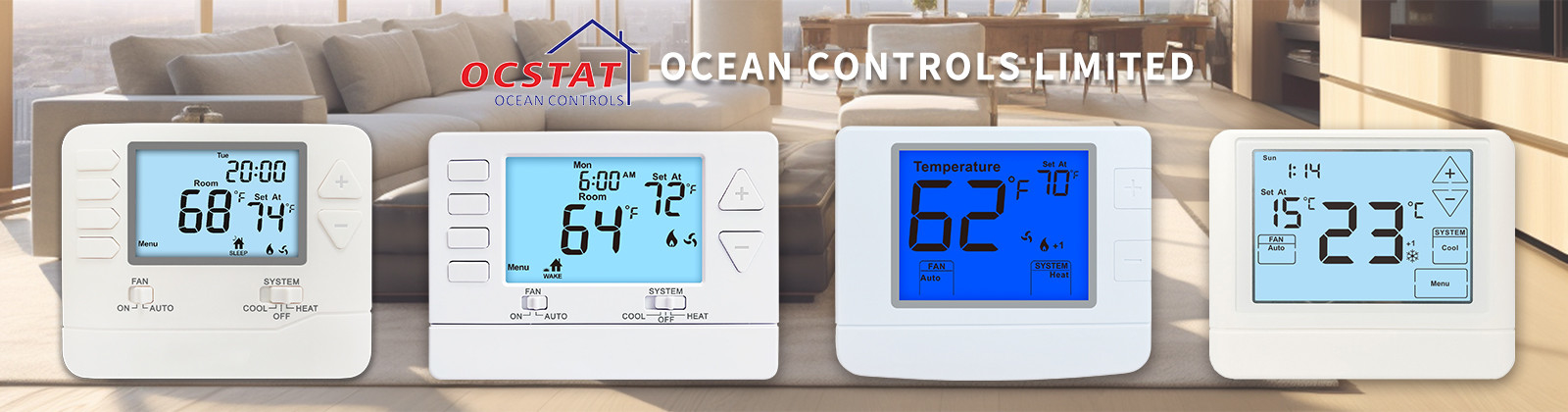
How Menu Driven Programming Makes Thermostats Smarter
In the world of modern technology, two concepts have been revolutionizing the way we interact with our environment: menu - driven programming and smart thermostats. Menu - driven programming offers a user - friendly interface where users can make selections from a list of options to perform various functions. On the other hand, a thermostat is a device that regulates the temperature of a space, and with the advent of technology, thermostats are becoming increasingly intelligent.
Today, we're going to explore how menu - driven programming is making thermostats smarter. We'll also take a closer look at Ocean Controls Limited, a leading company in this field, whose website www.room -
thermostats.com offers a wide range of innovative thermostat solutions.
1. Understanding Menu Driven Programming
Menu - driven programming is a software design approach where the user is presented with a list of options, or a “menu”. Each option corresponds to a specific function or operation within the system. For example, when you turn on your smartphone and access the settings, you are greeted with a menu. You can choose options like “Wi - Fi”, “Bluetooth”, “Display”, etc. Each of these menu items, when selected, leads you to a sub - menu or directly performs an action related to that setting.
In the context of computer software, a menu - driven program might be a simple text - based application. For instance, a file management utility where the main menu could have options like “Create New File”, “Open File”, “Delete File”, and “Exit”. The user selects an option, often by typing a number or using the arrow keys and the enter key, and the program then executes the corresponding function. This approach simplifies user interaction as it presents a clear and organized way to access different features without the need for users to remember complex commands.
2. The Basics of Thermostats
A thermostat is an essential device that plays a crucial role in maintaining a comfortable indoor environment. Its primary function is to sense the temperature of a space and then control heating or cooling systems to keep the temperature at a desired level.
How Thermostats Work
Most thermostats operate based on a simple principle. They contain a temperature - sensing element. In the case of older, mechanical thermostats, this is often a bimetallic strip. A bimetallic strip is made up of two different metals bonded together. Since different metals expand at different rates when heated, as the temperature changes, the bimetallic strip bends. This bending action can either close or open an electrical circuit, which in turn controls the heating or cooling equipment. For example, when the temperature drops below the set point, the bimetallic strip bends in a way that closes the circuit, turning on the heater. When the temperature rises above the set point, the strip bends in the opposite direction, opening the circuit and turning off the heater.
Electronic thermostats, on the other hand, use more advanced temperature - sensing technologies such as thermistors or thermocouples. These sensors can accurately measure the temperature and send an electrical signal to a microcontroller. The microcontroller then processes this signal and sends commands to the heating or cooling system to adjust the temperature accordingly.
Common Types of Thermostats
- Mechanical Thermostats: These are the most traditional type. They are relatively simple in design and operation. As mentioned before, they use a bimetallic strip or a bellows - type mechanism (which works on a similar principle of expansion and contraction in response to temperature changes). Mechanical thermostats usually have a dial or a set of buttons to adjust the temperature setting. They are often found in older buildings or in some basic heating and cooling systems due to their low cost and simplicity. However, they are not as precise as their electronic counterparts. For instance, a mechanical thermostat might have a temperature swing of a few degrees around the set point.
- Electronic Thermostats: These offer greater precision and more features. They can be programmed to adjust the temperature at different times of the day. For example, you can set it to lower the temperature at night when you're sleeping or when you're away from home during the day, helping to save energy. Electronic thermostats also often have a digital display, making it easy to read the current and set temperatures. Some can even communicate with other smart home devices, which is a stepping - stone towards the development of smart thermostats.
Traditional vs. Smart Thermostats
Traditional thermostats, whether mechanical or basic electronic, are limited in their functionality. They can only be adjusted manually on - site, and they don't have the ability to adapt to changing conditions or user habits over time.
Smart thermostats, on the other hand, are a new breed of thermostats that incorporate advanced technologies such as Wi - Fi connectivity, sensors, and artificial intelligence. They can be controlled remotely through a smartphone app. So, if you're on your way home from work and want to have the house at a comfortable temperature by the time you arrive, you can simply adjust the thermostat settings using your phone. Smart thermostats can also learn your temperature preferences over time. For example, if you usually set the temperature to 22°C in the evenings, after a few days or weeks, the smart thermostat will start to adjust the temperature to 22°C automatically at that time without you having to manually set it. This is where menu - driven programming comes into play, as we'll explore in the next section.
3. Ocean Controls Limited: A Pioneer in Thermostat Technology
Ocean Controls Limited has established itself as a significant player in the thermostat technology landscape. Founded with a vision to revolutionize temperature control solutions, the company has been at the forefront of innovation in the field of thermostats for over a decade.
Company Background
Based in Dongguan, Guangdong, China, Ocean Controls Limited has a rich history of designing and manufacturing top - end electronic room thermostats. Since its inception in 2002, the company has grown steadily, leveraging its in - depth knowledge and expertise in thermostat technology. It has built a reputation for quality and reliability, which has enabled it to expand its market reach globally.
Product and Service Offerings
The company offers a diverse range of thermostat products. Their lineup includes non - programmable and programmable thermostats, with options for different power sources such as 24V, 16V, and battery - operated models. For example, they have the 24V Programmable Electronic Room Thermostat / 2 Heat 2 Cool Thermostat, which is ideal for complex heating and cooling requirements in large homes or commercial spaces.
In addition to standard models, Ocean Controls Limited also provides thermostats with unique features. Some of their products come with large - screen displays, making it easy for users to view and adjust settings. Their 7 - day programmable thermostats allow users to set different temperature schedules for each day of the week, optimizing energy usage. For instance, you can set the temperature to be lower during the day when you're at work and warmer in the evenings when you're at home.
The company also offers OEM/ODM services to worldwide customers. This means that they can customize thermostat solutions according to the specific needs of their clients, whether it's for a large - scale commercial project or a unique residential application. From manufacturing to design, engineering, and tooling, Ocean Controls Limited provides a one - stop - shop for thermostat - related needs.
Quality and Reliability
One of the hallmarks of Ocean Controls Limited's products is their unrivalled quality, reliability, and durability. The company uses high - quality materials and advanced manufacturing techniques to ensure that each thermostat meets the highest standards. Their products are tested rigorously before being released into the market, which gives customers the confidence that they are investing in a long - lasting and efficient temperature control solution. This commitment to quality has enabled them to export their products to all over the world, with a strong presence in European and American markets. You can explore their full range of products and learn more about their quality - control processes on their website, www.room -
thermostats.com.
4. How Menu Driven Programming Transforms Thermostats
4.1 Enhanced User Interface
Menu - driven programming has significantly enhanced the user interface of thermostats, making them more intuitive and user - friendly. In the past, adjusting a thermostat could be a cumbersome task. For example, on some older mechanical thermostats, you had to physically turn a dial, and it was often difficult to precisely set the desired temperature. Even with basic electronic thermostats, the controls were limited, and you might have to press multiple buttons in a specific sequence to make simple adjustments.
With menu - driven programming, the process has been greatly simplified. Modern thermostats, like those offered by Ocean Controls Limited (available at www.room -
thermostats.com), present users with clear and organized menus. For instance, when you want to adjust the temperature, you simply navigate to the “Temperature Settings” menu. From there, you can use the arrow keys or a touch - screen interface to increase or decrease the temperature. Some thermostats even have sub - menus for more detailed settings, such as setting a temperature offset for different rooms in the house.
Moreover, menu - driven programming allows for personalized temperature settings. You can create profiles for different family members or for various activities. For example, you can have a “Sleep” profile where the temperature is set to a cooler, more comfortable level for sleeping, and a “Wake - up” profile that gradually warms up the room in the morning. These profiles can be easily accessed and activated through the menu system, providing a seamless and customized user experience.
4.2 Advanced Functionality
Menu - driven programming has enabled thermostats to offer a wide range of advanced functionality that goes beyond basic temperature control.
定时设置:One of the most useful features is the ability to set schedules. Through the menu, users can program the thermostat to adjust the temperature at different times of the day or days of the week. For example, you can set the thermostat to lower the temperature when you're at work during the day and raise it again when you're expected to return home. Ocean Controls Limited's programmable thermostats allow for very detailed scheduling. You can set different temperature levels for specific hours of each day, optimizing energy usage and ensuring comfort when you need it most.
节能模式:Energy - saving modes are another significant addition. With menu - driven programming, thermostats can be configured to enter an energy - saving mode automatically under certain conditions. For instance, if the thermostat detects that no one is home (using features like motion sensors or integration with smart home systems), it can switch to an energy - saving mode where the heating or cooling is reduced. This not only helps to save on energy bills but also contributes to environmental sustainability. Some thermostats also have a “Eco - mode” option in the menu, which adjusts the temperature set - points slightly to maximize energy efficiency without sacrificing too much comfort.
远程控制:Remote control via a smartphone app or other smart devices is also made possible by menu - driven programming. Ocean Controls Limited's thermostats can be connected to Wi - Fi, allowing users to access and control them from anywhere using their mobile phones. The app interface is also menu - driven, making it easy to view the current temperature, adjust settings, and check the thermostat's status. For example, if you're on vacation and realize you forgot to turn down the thermostat at home, you can simply open the app, navigate to the appropriate menu, and make the necessary adjustments.
4.3 Improved Adaptability
Menu - driven programming has made thermostats more adaptable to different environments and user needs. Thermostats can now use sensors and algorithms to gather data about the indoor and outdoor environment, and then adjust their operation based on this information.
For example, some advanced thermostats can detect the outdoor temperature through a connected weather service. If it's a particularly cold day outside, the thermostat can automatically adjust the heating schedule to ensure the indoor temperature remains comfortable. Similarly, if the indoor humidity levels are too high or low, the thermostat can be programmed through the menu to activate a dehumidifier or humidifier (if connected).
User habits also play a crucial role in the adaptability of thermostats. Menu - driven programming allows thermostats to learn and adapt to a user's temperature preferences over time. If you usually set the temperature to a certain level in the evenings, after a few days or weeks, the thermostat can start to adjust the temperature to that level automatically without you having to manually set it each time. This adaptability not only provides convenience but also ensures that the thermostat is always operating in a way that meets the user's comfort and energy - saving goals.
5. Real - world Benefits of Smarter Thermostats
5.1 Energy Efficiency
One of the most significant advantages of smarter thermostats enhanced by menu - driven programming is their ability to improve energy efficiency. These advanced thermostats can precisely control the heating and cooling systems, reducing unnecessary energy consumption.
For example, they can be programmed to lower the temperature when no one is at home or during times when less heating or cooling is required. According to a study by the Department of Energy, households with smart thermostats can save up to 10 - 15% on heating and cooling costs. In a large commercial building, the savings can be even more substantial. Ocean Controls Limited's programmable thermostats, available on www.room -
thermostats.com, allow for detailed scheduling. You can set different temperature levels for various times of the day, ensuring that the heating or cooling system is only operating when necessary. This not only cuts down on energy bills but also reduces the overall carbon footprint, contributing to a more sustainable environment.
5.2 Comfort Enhancement
Smarter thermostats offer a personalized and comfortable indoor environment. Thanks to menu - driven programming, users can easily customize temperature settings according to their preferences and daily routines.
For instance, different family members may have different temperature preferences. With a smart thermostat, you can create individual profiles for each person. A person who likes a warmer bedroom at night can have their own “Sleep” profile with the desired temperature setting. The thermostat can also be set to automatically adjust the temperature throughout the day. It can warm up the house gradually in the morning before you wake up, and cool it down in the evening when you're relaxing at home. This automatic adjustment ensures that the indoor temperature is always at an optimal level, providing a more comfortable living or working environment. In an office setting, a smart thermostat can be adjusted to maintain a comfortable temperature for employees, improving productivity and well - being.
5.3 Integration with Smart Home Systems
Smart thermostats can integrate seamlessly with other smart home devices, creating a unified and intelligent home ecosystem. This integration allows for greater convenience and enhanced functionality.
For example, a smart thermostat can be connected to a smart speaker. You can then use voice commands to adjust the temperature. “Hey [Smart Speaker Name], set the temperature to 25°C” becomes a simple and convenient way to control the thermostat. It can also be integrated with smart locks. When you unlock the front door with your smart lock, the thermostat can detect your arrival and adjust the temperature to your preferred setting. Another example is integration with smart blinds or curtains. On a sunny day, when the sun's rays start to heat up the room, the thermostat can communicate with the smart blinds to close them, reducing the need for excessive cooling. Ocean Controls Limited's thermostats, with their advanced technology, are well - equipped to integrate with a wide range of smart home systems, bringing the benefits of a fully - connected smart home to users.
6. The Future of Menu Driven Programming in Thermostats
As technology continues to advance at a rapid pace, the future of menu - driven programming in thermostats holds great promise. We can expect to see even more innovative features and applications that will further enhance the functionality and user experience of these devices.
Integration with AI and Machine Learning
One of the most significant trends on the horizon is the deeper integration of menu - driven thermostats with artificial intelligence (AI) and machine learning (ML). AI - powered thermostats will be able to analyze vast amounts of data from various sources, such as weather forecasts, occupancy sensors, and historical temperature usage patterns. For example, an AI - enabled thermostat could predict when a user is likely to arrive home based on their daily commute patterns and the current traffic conditions. It could then adjust the temperature accordingly, ensuring a comfortable environment upon the user's arrival.
Machine learning algorithms will also play a crucial role in optimizing energy usage. Thermostats will be able to learn from past behavior and automatically adjust their settings to maximize energy efficiency. For instance, if the thermostat notices that the user always turns down the temperature when leaving for work in the morning, it can start to make these adjustments automatically over time. Ocean Controls Limited, with its commitment to innovation (as seen on www.room -
thermostats.com), may very well incorporate these advanced AI and ML technologies into their future thermostat models, setting new standards in the industry.
Big Data Analytics for Personalized Experiences
Big data analytics will enable thermostats to provide highly personalized experiences. By collecting and analyzing data about a user's preferences, lifestyle, and even health conditions, thermostats can offer tailored temperature settings. For example, if a user has a medical condition that requires a specific temperature range for comfort, the thermostat can be programmed to maintain that range consistently.
Moreover, big data can be used to analyze the performance of thermostats across different environments and user groups. This information can then be used by manufacturers like Ocean Controls Limited to improve their products, develop new features, and provide better customer support. For instance, if data shows that a particular model of thermostat has a higher failure rate in a certain climate, the company can investigate and make improvements to enhance its reliability.
Expanding Application Scenarios
The application scenarios for menu - driven thermostats are also likely to expand. In addition to residential and commercial buildings, we may see thermostats being used in more specialized environments. For example, in agricultural settings, thermostats can be used to regulate the temperature in greenhouses, ensuring optimal growing conditions for plants. In data centers, precise temperature control is crucial for the efficient operation of servers, and menu - driven thermostats can provide the necessary level of control and monitoring.
In the future, we may also witness the integration of thermostats with other emerging technologies such as virtual reality (VR) and augmented reality (AR). Imagine being able to use AR glasses to view and adjust the thermostat settings in a more immersive and intuitive way. This could revolutionize the way we interact with our thermostats and further enhance the smart home experience.
Overall, the future of menu - driven programming in thermostats is bright. With continued advancements in technology, we can look forward to more intelligent, efficient, and user - friendly thermostats that will not only keep our living and working spaces comfortable but also contribute to a more sustainable and connected world. As companies like Ocean Controls Limited continue to innovate and lead the way, the thermostat industry is set to undergo even more exciting transformations in the coming years.